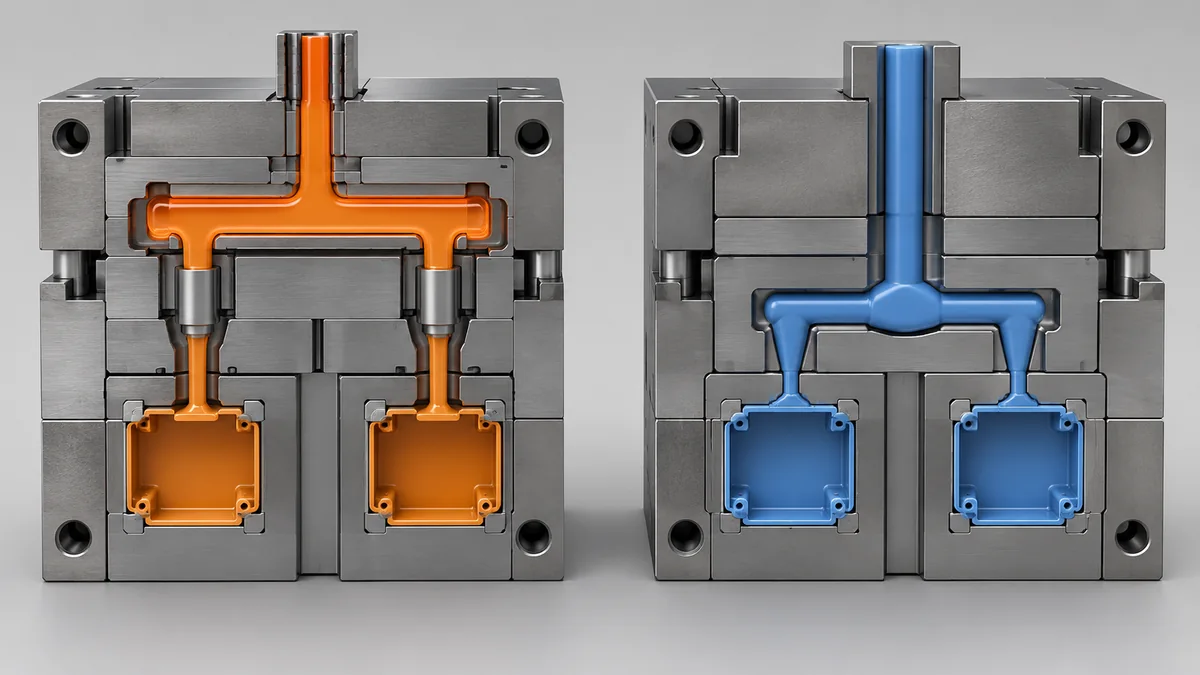
A runner system is part of the production plan, not simply an accessory selected after the cavity layout. It influences melt delivery, material handling, gate appearance and the equipment that must be ready when a mold reaches the press. Choosing between hot and cold runners therefore starts with your resin, part requirements and operating conditions.
This comparison concerns thermoplastic injection molding. Other processes can use different thermal arrangements, so their terminology and requirements should be evaluated separately. Neither runner type is universally better, and a project may combine a hot manifold with a short cold runner.
What changes between the systems?
In a cold runner mold, the feed channels cool along with the molded part. The solid runner must be removed from the mold and separated from the part, either during the cycle or through a subsequent operation. Runner geometry, gate design and handling determine how that separation works in practice.
A hot runner uses heated components to keep resin in the delivery system between cycles. It requires temperature control and an appropriate interface with the mold and machine. Husky’s hot runner fundamentals explain the basic architecture. Direct hot gating can reduce solid runner material, but startup, purging and rejected parts still consume resin.
Begin with the material balance
For a small part, the cold runner may represent a meaningful share of the shot. Compare part mass and runner mass for the proposed layout, rather than using part size alone as a shortcut. Ask what happens to the separated runner: disposal, external recycling and regrinding back into production are different operating assumptions.
Regrind eligibility depends on the resin, appearance and customer requirements. It should not be assumed to be permitted or cost-free. Include handling, segregation and quality controls in the comparison. The relevant number is the cost of acceptable parts under your actual material policy, rather than resin injected into the mold without accounting for its destination.
Check the resin’s processing window
A heated delivery system must suit the exact resin grade and expected operating conditions. Discuss thermal sensitivity, residence time, shear and the likelihood of interruptions with the resin producer and hot runner supplier. Small shots and long pauses deserve particular attention because the material’s time in the system may differ from what a simple cycle estimate suggests.
The Covestro mold design guide discusses hot runner tradeoffs, including added construction and maintenance complexity. Use the selected resin’s guidance to evaluate the proposed arrangement. A broad label such as “engineering plastic” is not enough to approve a melt delivery system.
Agree the gate quality you need
Hot tip and valve gate arrangements address gating differently. A valve gate uses a moving pin to control the opening; a hot tip relies on its thermal and geometric arrangement. Neither term by itself guarantees an invisible gate, freedom from stringing or a particular cosmetic result.
Identify permissible gate locations and acceptable vestiges on the drawing. Include assembly interfaces and visible surfaces in the review. Protolabs’ gating discussion illustrates why gate selection depends on geometry and material. Also consider how the part will be held or supported if trimming is necessary. A gate that is easy to place in CAD may be awkward to finish consistently.
Review cavity balance and cooling together
A geometrically balanced layout is a useful starting point, but it does not establish identical filling conditions at every cavity. Resin behavior, pressure loss, gate details and thermal conditions also matter. Discuss the basis of any proposed flow analysis and the acceptance checks used during trials. Synventive describes these inputs in its mold fill analysis overview.
Cooling must be considered around the delivery system as well as the part. Husky’s product handbook illustrates gate cooling and system interfaces. A hot runner can remove runner cooling from the cycle, but it does not remove the time needed to cool and eject the actual part.
Include color changes and maintenance
If the production plan includes frequent color or resin changes, ask how the chosen system will be purged and how acceptable changeover will be judged. Color retention depends on the material, channel design and operating procedure. Do not transfer a purge schedule from a different resin or system without review.
Maintenance planning should cover heaters, thermocouples, gate components, wiring and the work needed to gain access. Check the controller connection standard and spare-parts availability at the receiving facility. Mold-Masters user manuals show the system-specific nature of operating and maintenance instructions; the manual for the purchased system should accompany the tool.
Compare total cost with explicit assumptions
Use the same production plan for both options: acceptable annual volume, resin cost, part and runner weights, expected cycle, scrap assumptions, labor, changeovers, maintenance and initial investment. Show uncertain inputs as scenarios rather than hiding them in one optimistic payback number. A hot runner premium may be justified in one scenario and difficult to recover in another.
Finally, confirm what equipment and responsibilities are included in the quote. Identify the controller, cables, valve actuation requirements, startup documentation and trial acceptance criteria. Share your molding machine and operating constraints before approving the system. A well-chosen runner is the one that fits the part and can be run and maintained by the receiving molding team.
Sources and further reading
Supplier examples describe their own products. They do not establish a universal performance guarantee or any tooling supplier’s available capabilities.